It’s getting hotter and dryer and the ants can tell. I woke up this morning and saw some good sized trails in our kitchen. My wife and I have this battle every year and here are some tips we’ve picked up:
1. Unequivocally, the most important thing is to take away their food source. ie; clean! The pesticides and other chemicals are all useless if there is food exposed (especially sweet stuff).
2. Boric acid. Get it. Have it around. It ROCKS.
3. Ant “motel” type traps. these actually are just poison “baits” where the ants go in and bite off chunks of sweet tasting poion and then go elsewhere never to return again.
4. Use Boric acid or whatever other chemicals you prefer along the perimeters of your home along with any crack or crevice where ants seem to be getting in. There has to be a passageway . . . that’s the place to hit them.
5. Make sure you keep all food wiped off counters and all your food items in the pantry are sealed or closed tightly. After you do all these things for a couple days or maybe a week, the ants go find better and easier food sources.
Did I cover this well? Tell me what you do that I haven’t said?
Source: http://www.postcardsfromthefunnyfarm.com
Wednesday, November 12, 2008


Wednesday, November 05, 2008
Citronella Ants
The citronella ants get their name from the lemon verbena or citronella odor they emit when threatened. It is most noticeable when the ants are crushed. They are subterranean insects that feed on the honeydew (excretions) of aphids and mealybugs feeding on the roots of shrubs.
Both the larger and the smaller yellow ant are found throughout much of the continental United States. They are very common in the eastern United States and are frequently confused with termites when they swarm into the living areas of homes. In both species, the swarmers (winged ants) may vary in color from the more common light yellow to a dark reddish-yellow or light brown. The workers are typically yellow with less color variation than the swarmers.
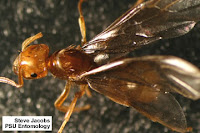 Description:
Of the two species, the larger yellow ant (A. interjectus) is the most commonly encountered in Pennsylvania homes (Fig. 1). The workers are 4 to 4.5 mm long and have 12-segmented antennae, with the scape (first antennal segment) just reaching the top of the head. They have a single node to the pedicel connecting the thorax and abdomen, with sparse, erect hairs on the head, thorax, and abdomen.
The swarmers are approximately twice the size of the workers and have dark, smoke-colored wings. Like the workers, they can also vary in color from a light yellow to light reddish-brown.
Other than its size (workers are 3 to 4 mm), the smaller yellow ant looks similar to the larger yellow ant.
Life History:
Little is known about the inner workings of these subterranean colonies. The ants are believed to tend aphids (much as dairy farmers would cows) and collect the honeydew they excrete. They are not known to forage for other food sources. Nest sites may include open woods, pastures and fallow fields, gardens, lawns, and next to house foundations. Also, some colonies are located beneath concrete slabs and large rocks, and in and beneath rotting logs.
Swarms may occur in and around homes any time of the year. The most common swarming occurs in mid- to late summer, but swarmers have been collected from homes during late autumn and early spring. These early and late season swarms are possibly an abnormality created by the warmer soils under and adjacent to heated structures.
Management:
Citronella ants should be considered only as a nuisance pest species. Normally, they go unnoticed unless the swarmers enter through expansion cracks in slabs or around door openings. Although these intrusions may alarm homeowners, the ants will not reproduce within the home nor will they attack stored goods or structures.
In some cases, swarms may occur repeatedly and attempts should be made to locate the colony or colonies. Colonies typically have mounds of soil around the openings where excavated soil is deposited. These mounds can be treated by injecting an insecticide into the holes. Although numerous insecticides are labeled for ant control, many of these can only be used by licensed individuals. Therefore, a professional pest control company should be contacted because they can use materials not available to the general public and have access to specialized application equipment.
Warning:
Pesticides are poisonous. Read and follow directions and safety precautions on labels. Handle carefully and store in original labeled containers out of the reach of children, pets, and livestock. Dispose of empty containers right away, in a safe manner and place. Do not contaminate forage, streams, or ponds.
*** Disclaimer ***
Authored by: Steve Jacobs
Sr. Extension Associate
April 2003
Reviewed January 2008
Source: http://www.ento.psu.edu
Orange Guard Water Based Indoor/Outdoor Home Pest Control - 32 oz Spray #103
Both the larger and the smaller yellow ant are found throughout much of the continental United States. They are very common in the eastern United States and are frequently confused with termites when they swarm into the living areas of homes. In both species, the swarmers (winged ants) may vary in color from the more common light yellow to a dark reddish-yellow or light brown. The workers are typically yellow with less color variation than the swarmers.
 Description:
Of the two species, the larger yellow ant (A. interjectus) is the most commonly encountered in Pennsylvania homes (Fig. 1). The workers are 4 to 4.5 mm long and have 12-segmented antennae, with the scape (first antennal segment) just reaching the top of the head. They have a single node to the pedicel connecting the thorax and abdomen, with sparse, erect hairs on the head, thorax, and abdomen.
The swarmers are approximately twice the size of the workers and have dark, smoke-colored wings. Like the workers, they can also vary in color from a light yellow to light reddish-brown.
Other than its size (workers are 3 to 4 mm), the smaller yellow ant looks similar to the larger yellow ant.
Life History:
Little is known about the inner workings of these subterranean colonies. The ants are believed to tend aphids (much as dairy farmers would cows) and collect the honeydew they excrete. They are not known to forage for other food sources. Nest sites may include open woods, pastures and fallow fields, gardens, lawns, and next to house foundations. Also, some colonies are located beneath concrete slabs and large rocks, and in and beneath rotting logs.
Swarms may occur in and around homes any time of the year. The most common swarming occurs in mid- to late summer, but swarmers have been collected from homes during late autumn and early spring. These early and late season swarms are possibly an abnormality created by the warmer soils under and adjacent to heated structures.
Management:
Citronella ants should be considered only as a nuisance pest species. Normally, they go unnoticed unless the swarmers enter through expansion cracks in slabs or around door openings. Although these intrusions may alarm homeowners, the ants will not reproduce within the home nor will they attack stored goods or structures.
In some cases, swarms may occur repeatedly and attempts should be made to locate the colony or colonies. Colonies typically have mounds of soil around the openings where excavated soil is deposited. These mounds can be treated by injecting an insecticide into the holes. Although numerous insecticides are labeled for ant control, many of these can only be used by licensed individuals. Therefore, a professional pest control company should be contacted because they can use materials not available to the general public and have access to specialized application equipment.
Warning:
Pesticides are poisonous. Read and follow directions and safety precautions on labels. Handle carefully and store in original labeled containers out of the reach of children, pets, and livestock. Dispose of empty containers right away, in a safe manner and place. Do not contaminate forage, streams, or ponds.
*** Disclaimer ***
Authored by: Steve Jacobs
Sr. Extension Associate
April 2003
Reviewed January 2008
Source: http://www.ento.psu.edu
Orange Guard Water Based Indoor/Outdoor Home Pest Control - 32 oz Spray #103
Red Velvet Ant or "Cow Killer"

Common Name: Red velvet ant or "cow killer"
Scientific Name: Dasymutilla occidentalis (Linnaeus)
Order: Hymenoptera
Description: These insects are wasps, not ants. Females are wingless and covered with dense hair, superficially resembling ants. The red velvet-ant is the largest velvet-ant species, reaching about 3/4 inch in length. They are black overall with patches of dense orange-red hair on the thorax and abdomen. Males are similar but have wings and can not sting.
Several other species of velvet ants are common in Texas, including the gray velvet ant or thistle down mutillid, Dasymutilla beutenmulleri, and D. fulvohirta. Most are solitary parasites of immature wasps (Vespidae and Sphecidae), solitary bees and some other insects such as beetles and flies. Winged males can be confused with other Hymenoptera. Adults of the tiphiid wasp, Myzinum sp. (Hymenoptera: Tiphiidae) are black and yellow, 3/4 inch long . They can occur in large numbers, sometimes on flowers of landscape plants. Larvae are parasites of white grubs (Coleoptera: Scarabeidae).
Life Cycle: Females seek the immature stages of ground-nesting bees, digging to the nesting chambers and eating a hole through the cocoon. She deposits and egg on the host larva, which soon hatches into a white legless grub. The immature velvet-ant eats the host larva, developing through several larval stages before forming a pupa.
Habitat, Food Source(s), Damage: Mouthparts are for chewing. Lone females can be found crawling on the ground, particularly in open sandy areas. Adults are most common during the warm summer months. Larvae are solitary, external parasites of developing bumble bees.
Pest Status: The common name, "cow killer," is thought to describe the painful sting these insects can inflict to man and animals, although it is doubtful that many cows are actually stung.
Source: http://insects.tamu.edu
KLEEN FREE NATURALLY, 32oz, Bed Bugs, Scabies, Lice, Mites, any Insect Eliminator and Treatment, all Natural Enzymes, Non-Toxic, Organic, USDA Ecologically Safe, Insect Eliminator, Treatment and Cleaner - (32 oz. Concentrate)

SENORET CHEMICAL 300 "TERRO" LIQUID ANT BAITS BX6

Subscribe to:
Posts (Atom)