Tuesday, June 22, 2010
the Myrmecocystus honeypots
Sometimes raiders from other colonies will attempt to kidnap the resident honeypot ants because of their relatively high nutritional value.
The insects are edible and form an occasional part of the diet of various Australian Aboriginal peoples.
Several different groups of ants have independently evolved a honeypot lifestyle. The best known are the Myrmecocystus honeypots of western North America and Camponotus inflatus of Australia.
Tuesday, December 15, 2009
Finding a Queen Ant
a. You can dig her nest up and find her. This is a tedious and difficult method and may not always be successful. The queen is very difficult to get. --Ant
I have done this numerous times. For Formicas (larger small mound building species) I use:
1. Spade shovel
2. 2 five gallon buckets
3. 2 covers for buckets
4. Metal spoon.
5. Newspaper (a section will do)
6. Jars/bucket with 1-2" inside near rim treated with oil
The process I use is to locate less developed nests (smaller). Then I carry shovel, buckets, and covers to site of nest during mid to late day (when sun has warmed upper soil).
Next, I cut a circle around colony usually about size of bucket or smaller if possible. Think of this like cutting a 6" deep hole of sod; but don't pull up the section until you have made your circular cut. When your ready lift the whole section out of ground -- intact if possible -- put in first bucket. Then while the nest is disturbed, begin to quickly dig the rest of the soil following chambers and tunnels until few ants are found or bucket(s) are full. As buckets get full, place covers on them.
Now, take the bucket(s) home and begin to manually sort (using spoon, newspapers for the refuse soil and jars/bucket to put the workers, pupae, larvae, eggs in while looking for the queen(s). Once the queen is obtained, then one can decide whether to keep sorting to obtain more workers or eggs, larvae pupae, etc. I have found eggs are very difficult to spot in many species unless they are still in wads of multiple eggs.
Under large rocks mid-day or there about: Similar process as above, but usually one doesn't need to get as much soil and one may see immediately the queen. I've turned large blocks many times and seen huge colonies -- with a queen scrambling for cover. --Mr. Ant
b. Rotting boards are good candidates. In West Virginia this summer (1999), I found three species all with queens under a rotting dog house we had to move.
Carpenter ant queens, at least in Michigan, can relatively easily be found in late fall or early spring (in cool temperatures) by locating a large tree stand with a fair amount of downed and rotting logs. By carefully peeling off the bark one should easily be able to find a carpenter queen with her first brood (in some stage) in a egg shaped chamber between bark and wood of tree. Being prepared with collection jars (large mouthed mason work great) and sharp long knife. One places a small section of bark over the 1.5" oval chamber
and cuts into the tree to extract completely the 1.5" oval chamber and surrounding wood. --Mr. Ant
c. Wait for the nuptial flights during the spring and summer seasons. The new queen ants usually fly away after a rain storm during a warm temperature. It depends where you are, and the development of the colony. Most species of ants will mate in late spring and summer (June through August). --Ant and Angelo Scott
Nuptial flights are the best time to get queens. Many times I seem to miss them for various reasons. The best reason to get nuptial queens is they are MUCH less sensitive to light than full blown native colonies (which I have observed take some time to acclimatize to light). Also, you get to see the full development cycle. It is important make sure to feed your queen before she enters the chamber as this will give her a much larger first brood than otherwise would have occurred. She will greedily gorge herself and then you can finally put her in your terrarium. --Mr. Ant
d. Finding colonies with queens is best done during the first really warm weather of spring. At this time, queens come near the surface to warm up (just as they later retreat into the depths to keep cool once hot weather fully sets in). Placing covering objects such as flat bricks, stones, or old boards over known nest sites will help induce the ants to come gather under these in a few days or a week, making it easier to capture a whole colony. When you find the queen, capture her FIRST in a small container, and THEN go about scooping up the rest of the colony. Queens are very shy, and hide quickly
at the first disturbance of the colony. --Dr. Ant
Source from http://www.antstuff.net
Saturday, January 10, 2009
Argentine Ants
The Argentine ant (Linepithema humile, formerly Iridomyrmex humilis) is a tiny dark ant native to northern Argentina, Uruguay, Paraguay, and southern Brazil. The species has been inadvertently introduced by humans to many other areas of the world, such as South Africa, New Zealand, Japan, Easter Island, Australia, Hawaii, Europe, and the United States.The worker ants are only about 3 mm (1/8th inch) long and can easily squeeze through cracks and holes no more than 1 mm (0.040 inch) in size. Queens are two to four times the length of workers. These tiny ants will set up quarters in the ground, in cracks in concrete walls, in spaces between boards and timbers, even among belongings in human dwellings.
German entomologist Dr. Gustav L. Mayr identified the first specimens of Hypoclinea humilis in the vicinity of Buenos Aires, Argentina in 1866. This species was shortly transferred to the genus Iridomyrmex, and finally to Linepithema in the early 1990s.
Source: http://antfarmz.net
Monday, December 29, 2008
Thief Ant
Solenopsis molesta, also known as thief ants, get their names because they often raid other ants’ nests for food and to steal eggs. They are also called grease ants because they are attracted to grease. S. molesta range anywhere from 1/32 (0.5 mm) of an inch to 1/8 (3 mm) of an inch long. They can be yellowish or brownish tones of color. These ants have a two-segmented petiole connecting their abdomen to the thorax. They have 10 segments in their antennae, which end in large segmented clubs. Thief ants have small stingers on their oblong abdomen, and generally have small eyes. Worker ants have large jaws for carrying food back to the colony.
The habitat of Solenopsis molesta is infinite, because they can survive just about anywhere. They can live in people’s homes, in the cracks or under the floorboards. They can build nests anywhere, such as under rocks, in any exposed soil, and rotting logs. If they cannot find any of these things, then they move into another colony. Their nests are generally large for the ants’ size, and have tunnels that lead to another ant colony for a reliable and steady food source.
Source: http://antfarmz.netWednesday, November 12, 2008
5 Tips on Killing Ants in Your Home
1. Unequivocally, the most important thing is to take away their food source. ie; clean! The pesticides and other chemicals are all useless if there is food exposed (especially sweet stuff).
2. Boric acid. Get it. Have it around. It ROCKS.
3. Ant “motel” type traps. these actually are just poison “baits” where the ants go in and bite off chunks of sweet tasting poion and then go elsewhere never to return again.
4. Use Boric acid or whatever other chemicals you prefer along the perimeters of your home along with any crack or crevice where ants seem to be getting in. There has to be a passageway . . . that’s the place to hit them.
5. Make sure you keep all food wiped off counters and all your food items in the pantry are sealed or closed tightly. After you do all these things for a couple days or maybe a week, the ants go find better and easier food sources.
Did I cover this well? Tell me what you do that I haven’t said?
Source: http://www.postcardsfromthefunnyfarm.com
Wednesday, November 05, 2008
Citronella Ants
Both the larger and the smaller yellow ant are found throughout much of the continental United States. They are very common in the eastern United States and are frequently confused with termites when they swarm into the living areas of homes. In both species, the swarmers (winged ants) may vary in color from the more common light yellow to a dark reddish-yellow or light brown. The workers are typically yellow with less color variation than the swarmers.
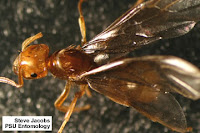
Description:Of the two species, the larger yellow ant (A. interjectus) is the most commonly encountered in Pennsylvania homes (Fig. 1). The workers are 4 to 4.5 mm long and have 12-segmented antennae, with the scape (first antennal segment) just reaching the top of the head. They have a single node to the pedicel connecting the thorax and abdomen, with sparse, erect hairs on the head, thorax, and abdomen.
The swarmers are approximately twice the size of the workers and have dark, smoke-colored wings. Like the workers, they can also vary in color from a light yellow to light reddish-brown.
Other than its size (workers are 3 to 4 mm), the smaller yellow ant looks similar to the larger yellow ant.
Life History:
Little is known about the inner workings of these subterranean colonies. The ants are believed to tend aphids (much as dairy farmers would cows) and collect the honeydew they excrete. They are not known to forage for other food sources. Nest sites may include open woods, pastures and fallow fields, gardens, lawns, and next to house foundations. Also, some colonies are located beneath concrete slabs and large rocks, and in and beneath rotting logs.
Swarms may occur in and around homes any time of the year. The most common swarming occurs in mid- to late summer, but swarmers have been collected from homes during late autumn and early spring. These early and late season swarms are possibly an abnormality created by the warmer soils under and adjacent to heated structures.
Management:
Citronella ants should be considered only as a nuisance pest species. Normally, they go unnoticed unless the swarmers enter through expansion cracks in slabs or around door openings. Although these intrusions may alarm homeowners, the ants will not reproduce within the home nor will they attack stored goods or structures.
In some cases, swarms may occur repeatedly and attempts should be made to locate the colony or colonies. Colonies typically have mounds of soil around the openings where excavated soil is deposited. These mounds can be treated by injecting an insecticide into the holes. Although numerous insecticides are labeled for ant control, many of these can only be used by licensed individuals. Therefore, a professional pest control company should be contacted because they can use materials not available to the general public and have access to specialized application equipment.
Warning:
Pesticides are poisonous. Read and follow directions and safety precautions on labels. Handle carefully and store in original labeled containers out of the reach of children, pets, and livestock. Dispose of empty containers right away, in a safe manner and place. Do not contaminate forage, streams, or ponds.
*** Disclaimer ***
Authored by: Steve Jacobs
Sr. Extension Associate
April 2003
Reviewed January 2008
Source: http://www.ento.psu.edu
Orange Guard Water Based Indoor/Outdoor Home Pest Control - 32 oz Spray #103
Red Velvet Ant or "Cow Killer"

Common Name: Red velvet ant or "cow killer"
Scientific Name: Dasymutilla occidentalis (Linnaeus)
Order: Hymenoptera
Description: These insects are wasps, not ants. Females are wingless and covered with dense hair, superficially resembling ants. The red velvet-ant is the largest velvet-ant species, reaching about 3/4 inch in length. They are black overall with patches of dense orange-red hair on the thorax and abdomen. Males are similar but have wings and can not sting.
Several other species of velvet ants are common in Texas, including the gray velvet ant or thistle down mutillid, Dasymutilla beutenmulleri, and D. fulvohirta. Most are solitary parasites of immature wasps (Vespidae and Sphecidae), solitary bees and some other insects such as beetles and flies. Winged males can be confused with other Hymenoptera. Adults of the tiphiid wasp, Myzinum sp. (Hymenoptera: Tiphiidae) are black and yellow, 3/4 inch long . They can occur in large numbers, sometimes on flowers of landscape plants. Larvae are parasites of white grubs (Coleoptera: Scarabeidae).
Life Cycle: Females seek the immature stages of ground-nesting bees, digging to the nesting chambers and eating a hole through the cocoon. She deposits and egg on the host larva, which soon hatches into a white legless grub. The immature velvet-ant eats the host larva, developing through several larval stages before forming a pupa.
Habitat, Food Source(s), Damage: Mouthparts are for chewing. Lone females can be found crawling on the ground, particularly in open sandy areas. Adults are most common during the warm summer months. Larvae are solitary, external parasites of developing bumble bees.
Pest Status: The common name, "cow killer," is thought to describe the painful sting these insects can inflict to man and animals, although it is doubtful that many cows are actually stung.
Source: http://insects.tamu.edu
KLEEN FREE NATURALLY, 32oz, Bed Bugs, Scabies, Lice, Mites, any Insect Eliminator and Treatment, all Natural Enzymes, Non-Toxic, Organic, USDA Ecologically Safe, Insect Eliminator, Treatment and Cleaner - (32 oz. Concentrate)
SENORET CHEMICAL 300 "TERRO" LIQUID ANT BAITS BX6
Extension Goals in Oklahoma
1. Reading the label. Insecticide labels provide important information about timing of application, proper rate of application, and the steps to take for best results. Granular insecticides used for individual mound treatments will have information on whether to water the product in or not, while dusts may stress the importance of uniform coverage of mounds. Extension personnel have encountered many situations where control failures were due to not following label instructions properly. Reading and interpreting labels is an integral part of our educational programs.
2. Monitoring for activity before treatment. We are intent on getting people in Oklahoma to demand the most bang for their buck when treating for fire ants. When using baits, homeowners and professionals can be certain that ants are active by placing an attractive substance (peanut butter, greasy potato chips, hotdog slices) out on the ground in the area to be treated and checking for activity. If ants discover and forage on the material within 20-30 minutes, it's time to bait. We are convincing people that by spending a couple of extra minutes they can insure that their money is well spent.
3. Reducing insecticide use. By relying on bait technology, homeowners and pest control professionals can cut the amount of active ingredient they apply to an area by several times. Extension personnel have assisted military personnel in Oklahoma in meeting IPM mandates, by switching from the "hunt and peck" method of treating mounds as they appear in a large area to baiting the area, resulting in less expense, greater levels of control, and less pesticide usage.
Source: http://entoplp.okstate.edu
KLEEN FREE NATURALLY, 32oz, Bed Bugs, Scabies, Lice, Mites, any Insect Eliminator and Treatment, all Natural Enzymes, Non-Toxic, Organic, USDA Ecologically Safe, Insect Eliminator, Treatment and Cleaner - (32 oz. Concentrate)
Big Headed Ant (Pheidole)

Brief Description:
Belonging to the Pheidole megacephala Family
Extended Description:
Big headed ants have two sizes of workers -- major workers (soldiers) and minor workers. Major workers have a very large head in proportion to their bodies. Big-headed ants are most often confused with fire ants, but imported fire ants do not have workers with larger heads. Big-headed ants usually nest in the soil in protected locations such as under rocks, logs, firewood, patio blocks and landscape timbers, although they will nest in open areas of soil. They typically feed on live and dead insects, seeds and the honeydew produced by insects such as aphids and scales. They are considered major predators of fire ant queens, which are present in large numbers after a fire ant swarm.
Pheidole megacephala. Workers are either major or minor workers; major workers have very large heads. They nest in the soil under logs, mulch, firewood and next to the foundation of buildings. They often trail along sidewalks and the sides of buildings. They often forage indoors for food and water. The ant is yellowish-brown and is 2 mm to 3 mm long. There are two nodes on the petiole, and colonies are polygyne.
Source: http://antfarmz.net
Crazy Ant

Brief Description:
Belonging to the Anoplolepis gracilipes Family
Extended Description:
These are small, dark gray to black ants that are easily recognized by their extremely long legs and antennae. Crazy ants get their name from their habit of running about very erratically with no apparent sense of direction. Colonies most often can be found living in soil, under items such as logs, stones, landscape timbers, wood, debris and above-ground swimming pools. Crazy ants feed on a wide variety of foods, including other insects, grease and sweets. They have been known to feed on the larvae of fleas and flies, and also have been observed carrying away fire ant queens immediately after a swarm.
Courtesy or http://agnews.tamu.edu/stories/ENTO/Jul1599x.htm
Size: total length around 4 mm.
Colour: body colour yellow, gaster brownish to greenish.
Surface sculpture: head and body mostly with inconspicuous sculpture; appearing more or less smooth and shining.
General description: head oval, antennae and legs remarkably long. Antennae 11-segmented, each segment longer than wide; scapes twice as long as the length of the head, or longer. Eyes relatively large and protruding. Mandibles each with 8 teeth. Clypeus protruding medially, with convex anterior margin; without longitudinal carinae. Alitrunk slender; pronotum narrow, with almost straight dorsum in profile. Anterior portion of mesonotal dorsum, back to the propodeum, gently concave in profile; metanotal groove absent. Propodeum without spines, propodeal dorsum convex in profile. One node (petiole) present; thick, with an inverted-U-shaped crest. Erect hairs present on head and gaster, lacking on dorsum of mesosoma. Stinger absent; acidopore present.
Source: http://antfarmz.net
Tuesday, November 04, 2008
Army Ant

There are over 200 known species of army ant, divided into New World and Old World types. All are members of the true ant family Formicidae.
New World army ants belong to the subfamily Ecitoninae. This subfamily is further broken into two groups, Cheliomyrmex and the Ecitonini. The Ecitonini group contains three genera, Neivamyrmex, Nomamyrmex, Labidus, and Eciton, the genus after which the group is named (Brady, 2003, Tree of Life). The most predominant species of Eciton is Eciton burchelli, whose common name is army ant and which is considered to be the archetypal species.
The Old World army ants are divided between the two subfamilies Aenictinae and Dorylinae.
The subfamily Aenictinae is made up of a single genus, Aenictus, that contains over 100 species of army ant.
The subfamily Dorylinae contains the aggressive driver ants. There are over 60 species known.
Army ant taxonomy remains ever-changing, and genetic analysis will continue to provide more information about the relatedness of the various species.
Source: http://antfarmz.net
Flying Ants
Spectacular swarms of flying ants are a common summer phenomenon. Sometimes people will observe winged ants issuing in large numbers, pushed out by the wingless workers, from a colony established between a sidewalk crack or in a small mound. Other times only the winged forms will be seen, aggregating in large numbers around certain prominent points in the landscape.Some background. Ants are social insects. The colony is established through the initial efforts of a mated "queen", a sexually mature female. Originally winged, after mating she sheds her wings and the no longer used wing muscles are an important source of nutrients for her during the early stages of colony development. Very, very few queens successfully survive this period and establish a functional colony.
However, if the colony makes it through this period it can begin to grow. Wingless, non-sexually mature workers are rearedwhich subsequently help expand the colony. After several years, the colony may be well-established and then some resources are put into rearing reproductive forms. These are the winged ants, some females - the potential future queens - and the majority males.
Periodically, usually following by 3-5 days a heavy rain, the winged reproductive forms emerge from the colony in large swarms. Such swarming behavior is usually synchronized by other nearby colonies so large numbers of winged ants suddenly appear. All mating for the species takes place, often over the course of a single day. The males die and the mated females disperse to attempt establishing a new colony.
One behavior associated with some ants during mating swarms is "hilltopping". This refers to their aggregation around prominent points of a landscape where they search for mates. A large tree, the chimney of a roof or even a tractor moving across the plains might serve as such an "action site" for swarming winged ants. My favorite hilltopping site was the top of the US West tower in downtown Denver, which annually is the site for millions of harvester ants to aggregate.
Although dramatic, swarming ants pose no harm or risk of increased ant infestation. Those seen emerging from a colony were always there and are in the process of leaving the colony permanently. Mated females amongst aggregating masses similarly disperse from the area.
However, in rare cases winged ants are seen moving into the house. In some cases it is likely that an established colony exists within the home and may need to be treated. Carpenter ants and pharaoh ants are two species that can produce a nest within a building.
Other ants, such as the field ants, commonly nest outdoors next to foundations and may incidentally swarm indoors, working their way indoors through foundation cracks. And harvester ants in the midst of hilltopping behavior may fall down chimneys. In these cases there is not risk of permanent household infestation.
By: Whitney Cranshaw, Colorado State University Cooperative Extension specialist, entomology
Photos: Judy Sedbrook.
Source: http://www.colostate.edu
Carpenter Ant
Hymenoptera: Formicidae, Camponotus spp.SIZE: Large - from 1/4 inch (6.4mm) for a worker up to 3/4 inch (19.1mm) for a queen
COLOR: Black, or sometimes red and black
DESCRIPTION: Carpenter ants are active indoors during many months of the year, usually during the spring and summer. When ants are active in the house during late winter/early spring (February/March), the infestation (nest) is probably within the household. When carpenter ants are first seen in the spring and summer (May/June), then the nest is likely outdoors and the ants are simply coming in for food. The natural food of the ants consists of honeydew from aphids, other insects, and plant juices, but they will readily forage for water and food scraps within the house.
HABITAT: Under natural conditions, carpenter ants nest in live and dead trees and in rotting logs and stumps. However, they will also construct their nests in houses, telephone poles, and other man-made wooden structures.
Nests are begun in deteriorating wood which has been exposed to moisture. Often, the colony will extend its nest to adjacent, sound wood. Nests are commonly found in porch pillars and roofs, window sills, and wood in contact with soil.
LIFE CYCLE: The colonies of carpenter ants are often long lived. Each colony is founded by a single fertilized queen. She establishes a nesting site in a cavity in wood. She then rears her first brood of workers, feeding them salivary secretions. She does not leave the nest nor feed herself throughout this period. The workers which are reared first assume the task of gathering food with which to feed the younger larvae. As the food supply becomes more constant, the colony population grows very rapidly. A colony does not reach maturity and become capable of producing young queens and males until it contains 2,000 or more workers. It may take a colony from three to six years or more to reach this stage. Each year thereafter, the colony will continue to produce winged queens and males, which leave their nest and conduct mating flights from May through July.
TYPE OF DAMAGE: Carpenter ants rarely cause structural damage to buildings, although they can cause significant damage over a period of years because nests are so long lived. Some recent evidence indicates that they can also cause extensive damage to foam insulation.
CONTROL: Control of carpenter ant infestations requires that the nest be found. Once this is done, the infested wood can be removed or treated chemically, and causes of moisture damage to the wood can be corrected. The best procedure is to inspect all possible locations-and to select these locations on the basis of potential water exposure. Once the nest is located, control can be achieved by the use of an aerosol insecticide labeled for the purpose.
INTERESTING FACTS: Ants of the genus Camponotus are known as carpenter ants because they house their colonies in galleries they excavate in wood. Carpenter ants do not eat the wood they remove during their nest-building activities, but deposit it outside entrances to the colony in small piles. The wood is used solely as a nesting site. The galleries of carpenter ants are kept smooth and clean, and are not lined with moist soil as termite galleries are.
Source : http://www.ext.vt.edu